Floor-standing foot-operated heat sealers are the workhorse equipment for medium-volume packaging operations across a wide range of industries. The equipment allows for hands-free operation, offers a wide range of seal width options, and features an ergonomic, upright design; when manual sealers are too inefficient and fully automatic sealers are too costly or lack flexibility, foot-operated sealers are the preferred solution.
Industry Application Categories
Apparel and Textile Industry
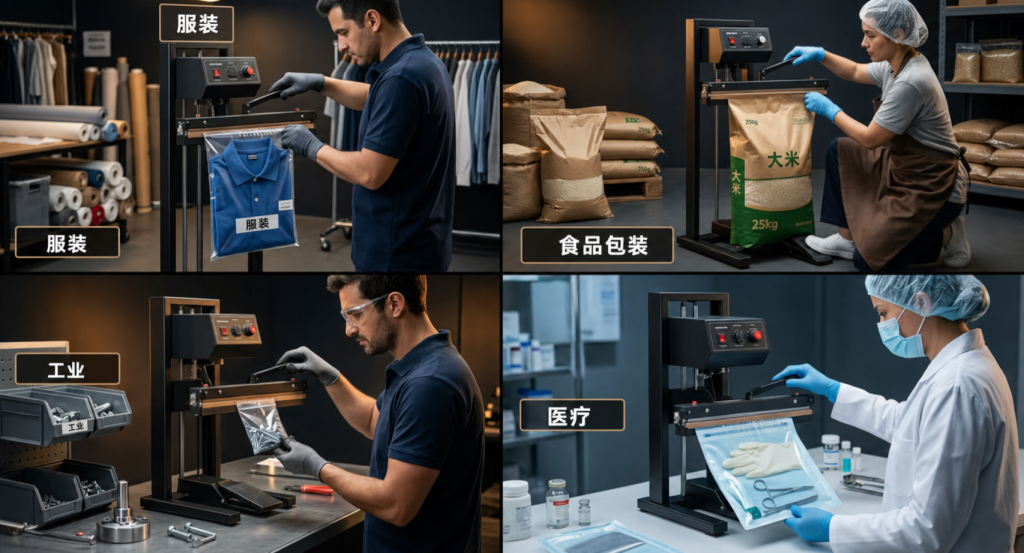
The apparel industry is the largest application area for foot-operated sealing machines. Individual garments, sets of folded clothing, and clothing accessories must be placed into plastic bags, a process that requires the coordination of both hands: one hand to smooth out the garments and the other to adjust the bag opening, making manual sealing machines difficult to operate.
The 400–600 mm wide sealing machines are suitable for standard garment packaging bags; the 800–1000 mm extra-wide machines can be used for packaging bedding, curtains, and rolls of fabric.
Common packaging bags: low-density polyethylene bags, oriented polypropylene plastic bags, 30–80 micrometers thick
Recommended Models: PFS-400 through PFS-600
Key Features: Wide sealing strip; the frame is equipped with casters, allowing for flexible movement between workstations
Food Packaging — Dry and Semi-Dry Goods
Snacks, cereals, dried fruits, coffee, spices, pet food, and baked goods can all be processed using foot-operated sealing machines at the packaging station. The standing operation aligns with the ergonomic design of the packaging station, and the foot-operated control switch allows operators to keep both hands free to continuously place products on the conveyor.
For food packaging that requires freshness preservation, an optional printing device is available to meet regulatory requirements for production date labeling.
Common packaging bags: nylon-polyethylene composite bags, oriented polypropylene bags, and kraft paper-polyethylene composite bags, with a thickness of 50–120 micrometers
Recommended Models: PFS-300 through PFS-500, with an optional date imprinter
Note: For foods containing water, pickled foods, and liquid foods, a chamber-type vacuum sealer must be used; foot-operated sealers are suitable only for dry and semi-dry products.
E-commerce Warehousing and Fulfillment
For high-volume order packaging scenarios—where clothing, electronic accessories, cosmetics, and various other products are packed into shipping bags and flat pouches—upright foot-operated sealing machines, when paired with elevated packing stations, offer significant efficiency advantages.
A single worker can seal 250–400 bags per hour, while a manual sealer can only handle 80–120 bags.
Common packaging bags: low-density polyethylene shipping bags, co-extruded polyethylene bags, 50–100 micrometers thick
Recommended Model: PFS-400 with Digital Timer Panel
Key Advantages: Can operate continuously for 6–8 hours, and operators are less likely to experience hand fatigue
Industrial Parts and Hardware Products
Fasteners, tools, small machine parts, and electronic hardware components are often packed in polyethylene bags for retail display or protective shipping. Many industrial parts have sharp edges or protruding features, requiring careful packing with both hands, making a foot-operated control system essential.
When packaging metal parts, anti-static strips are available as an option to prevent static electricity from causing metal dust to adhere to the surface of the bag.
Common packaging bags: high-density polyethylene bags, low-density polyethylene bags, with a thickness of 80–150 micrometers
Recommended Models: PFS-300 to PFS-400, with optional anti-static strips
Key Feature: Dual sealing strips, which enhance puncture resistance at the seal location
Medical and Pharmaceutical Supplies
Non-sterile medical supplies, pharmacy packaging, first-aid kits, and medical device accessories that require tamper-evident packaging can be sealed using a foot-operated sealer with stainless steel sealing surfaces and traceable sealing parameters.
Sterile-certified packaging requires specialized validation equipment; foot-operated sealers are suitable for a wide range of pharmaceutical packaging applications and meet GMP documentation requirements (no sterility validation required).
Common Packaging Bags: Medical-grade polyethylene, polypropylene, and Tyvek-laminated polyethylene bags
Recommended Models: PFS-400SS or PFS-600SS (stainless steel models)
Key Features: Parameters such as sealing width, temperature, and holding time can be saved, facilitating GMP record-keeping.
Printed Materials and Promotional Materials
Brochures, promotional booklets, product manuals, and promotional kits are often packaged in clear oriented polypropylene bags for retail display or mailing. Since these items are lightweight and require high-volume packaging, foot-operated sealing machines combine ergonomic design with production efficiency.
The integrated cutting and sealing machine (PFS-400CS) trims excess film while sealing, eliminating the need for a separate cutting process.
Common packaging bags: oriented polypropylene and cast polypropylene film, 20–40 micrometers thick
Recommended Models: PFS-300CS or PFS-400CS (Cut-and-Seal Machine)
Key Advantage: Sealing and cutting are completed in a single step, reducing processing time by approximately 30%