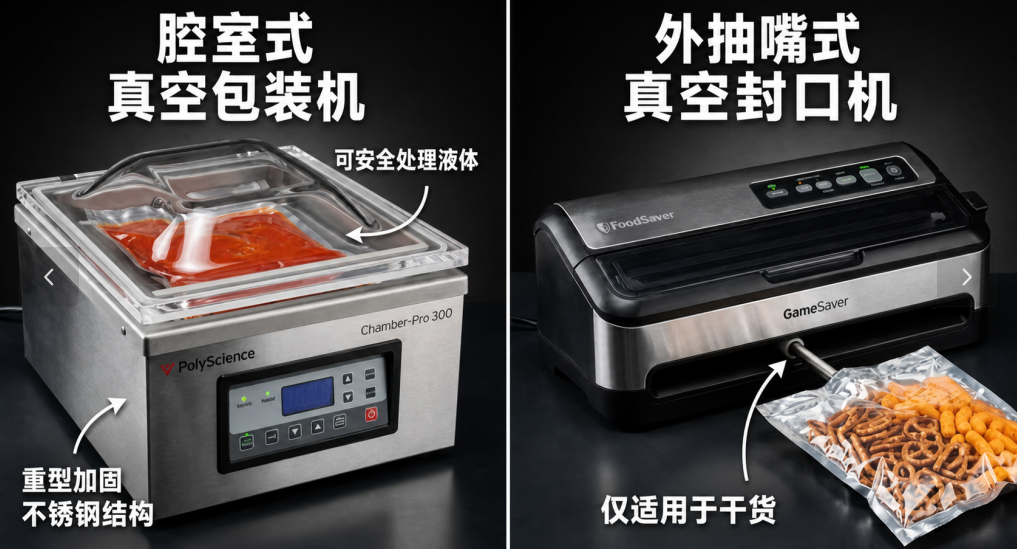
Nozzle-type external vacuum sealers (sometimes referred to as tube-insertion vacuum sealers) are entry-level vacuum packaging devices, and their market prices are generally low. A clear understanding of their strengths and weaknesses can help you avoid significant losses resulting from choosing the wrong model.
Advantages of Nozzle-Type Sealing Machines
Purchasing Cost: Starting price is lower than that of chamber-type equipment 60%–85%
Portability: Can be placed on any flat surface for use; no permanent installation required
Suitable for large packaging bags: The packaging bag is placed outside the machine, so its size is not limited by the chamber; suitable for packaging bulk goods and large cuts of meat longer than 60 centimeters. Dry, hard goods: Nuts, grains, coffee, dried herbs, etc.—products that can withstand external atmospheric pressure and are not prone to deformation.
Advantages of Chamber-Type Vacuum Machines (Unmatched by Nozzle-Type Models)
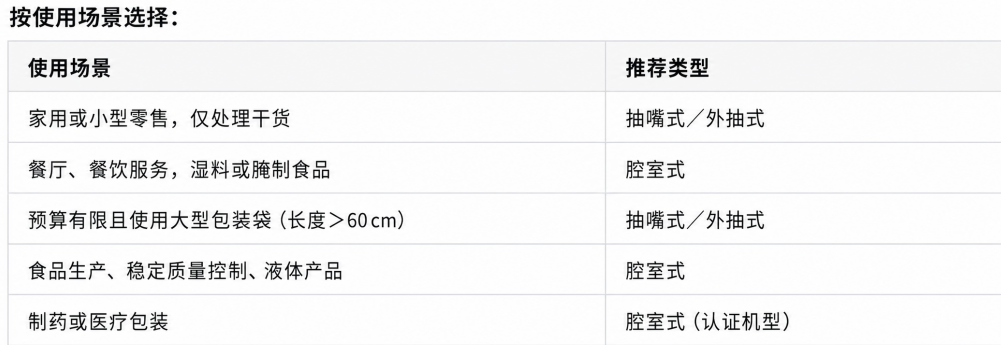
Liquid ingredients, marinades, and broths: Only chamber-type equipment may be used.
Maximum vacuum level: Chamber-type machines can consistently achieve –95 to –99 kPa; for nozzle-type machines, the maximum vacuum level is limited by the strength of the packaging film and is approximately –65 kPa.
Cost of packaging film consumables: Chamber-type machines can use standard, unembossed PA/PE composite film; nozzle-type machines must use embossed or channel-patterned packaging bags with higher stiffness, resulting in a per-bag cost that is 30%–50% higher.
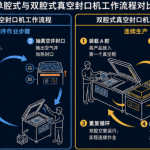
Operational Stability: The position of the nozzle insertion is affected by the operator’s technique, resulting in inconsistent sealing results; the performance of chamber-type machines is not affected by variations in manual operation. Mass Production: With nozzle-type machines, the exhaust nozzle must be inserted manually for each cycle, making it difficult to achieve large-scale automated production.