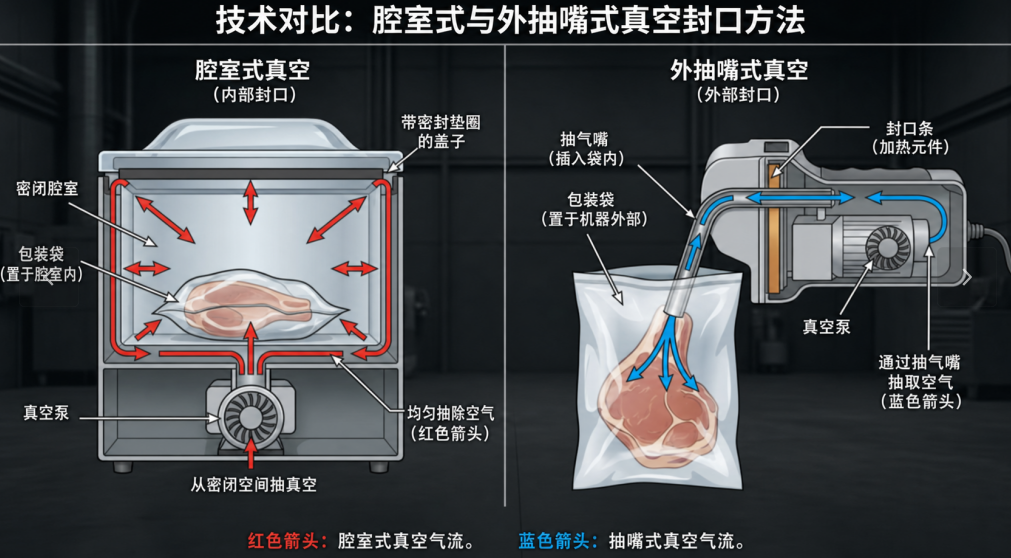
This is the most commonly misunderstood distinction in the field of vacuum packaging. “Internal vacuum” and “external vacuum” refer to the orientation of the packaging bag relative to the vacuum pump; these two factors directly determine the types of products that can be packaged and the level of vacuum that can be achieved.
Internal Vacuum (Chamber-Type Vacuum Sealer)
The entire packaging bag is placed inside a sealed chamber. Once the vacuum pump is activated, it extracts all the air from the chamber, equalizing the pressure inside and outside the bag. Since there is no pressure difference across the bag walls during the evacuation process, the packaging bag will not be compressed or deformed.
Key Advantages:
✅ Safely packages liquid products (no boiling or splashing of liquids due to pressure differentials)
✅ Soft, easily squishable products such as bread, potato chips, and pastries can retain their original shape
✅ Capable of achieving extremely high vacuum levels (up to –99 kPa)
✅ You can choose thinner, more cost-effective packaging film without needing to reinforce the film's strength.
External Vacuum (Nozzle-Type External Vacuum Packaging Machine)
The packaging bag is placed outside the equipment, with the vacuum nozzle inserted into the bag opening to extract only the air from inside the bag; the exterior of the bag remains at atmospheric pressure at all times. A significant pressure difference forms across the bag walls: the exterior is at standard atmospheric pressure (101 kPa), while the interior is close to a vacuum.
Resulting characteristics:
⚠️ The maximum vacuum level is limited by the strength of the packaging film (typically only –60 to –75 kPa).
⚠️ Liquid materials are prone to boiling and foaming and can be drawn into the vacuum pump; therefore, this device is not suitable for liquid products.
✅ Suitable for goods that are hard, dry, and can withstand external pressure