Once industrial-scale production is achieved, vacuum packaging is no longer merely a method for preserving freshness; if the wrong equipment is selected, it can become a bottleneck in the production capacity of the entire production line. For manufacturing enterprises with a daily output of 500 bags or more and a dedicated packaging team, the criteria for equipment selection will undergo a fundamental shift, with a focus on production capacity, stability, and total cost of ownership over the equipment’s lifecycle.
Target Customer Base
Food processing plants with full-time packaging line staff
A contract packaging company that manufactures products for multiple food brands
Frozen food manufacturers (frozen after vacuum packaging, or using a vacuum + individual quick-freezing process)
Meat processing plants, poultry processing plants, and seafood processing plants
Manufacturers of mass-produced ready-to-cook meals and low-temperature slow-cooking meal kits
Why Are Dual-Chamber Machines the Standard Configuration at This Scale?
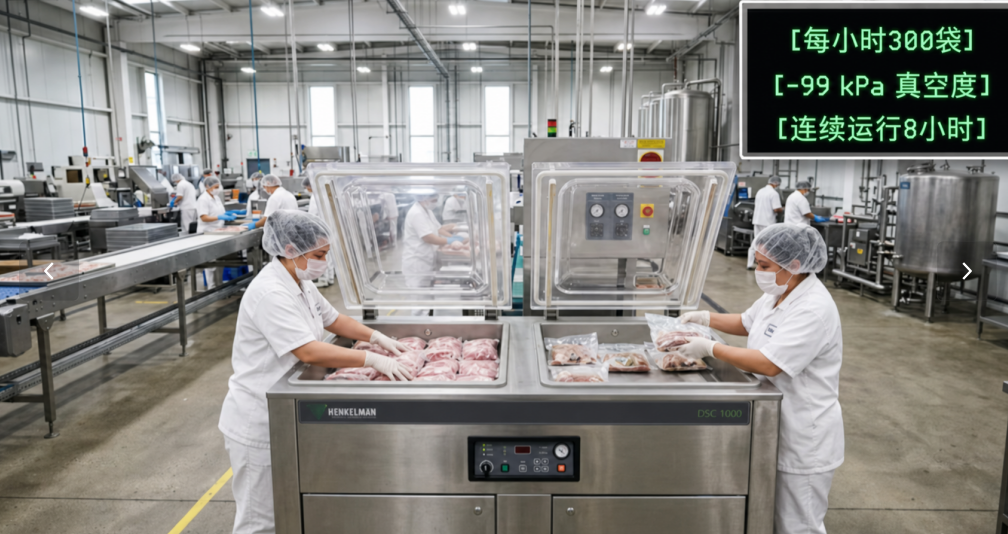
The single-chamber vacuum sealer is operated by a single person and has a production capacity of approximately 180 bags per hour; total output for an 8-hour shift is approximately 1,440 bags.
With the same number of operators, a double-chamber vacuum sealer can achieve a production capacity of 2,400–2,880 bags per shift, representing an increase of 67%–1,00%, without the need for additional labor. Based on 250 working days per year, this cumulative difference in production capacity translates to hundreds of thousands more packaged products annually.
Industrial-Grade Equipment Requirements:
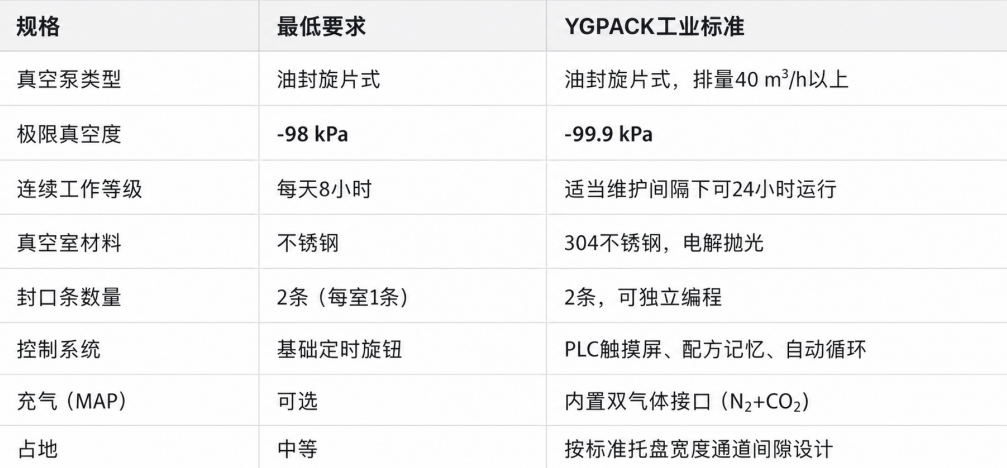
Three Production Line Configuration Options Categorized by Production Capacity
Tier 1 — 500–1,500 bags per day: Equipped with a single dual-chamber vacuum machine and one full-time operator. The oil pump follows standard maintenance schedules; this is an entry-level solution for industrial production.
Second Tier — 1,500 to 4,000 bags per day: Two dual-chamber vacuum machines operate in parallel, staffed by one supervisor. Schedule equipment maintenance in staggered shifts to avoid a complete production shutdown. Consider using a centralized vacuum pump system to facilitate inspection and maintenance.
Third Tier — Over 4,000 bags per day: Upgrade to a rotary (turntable) vacuum packaging machine or a thermoforming fill-seal production line to completely eliminate the manual loading process. Yiguang Packaging can provide consulting services on system configurations for factories operating at this production capacity level.
Key Checklist for Industrial Procurement
- Request the Factory Acceptance Test (FAT) documentation to confirm that the vacuum pump can achieve a ultimate vacuum of –99 kPa;
- Verify the control panel's protection rating (minimum standard for humid food production environments: IP54);
- Verify that all chamber contact surfaces have CE, FDA, or local food contact certifications;
- Confirm the delivery lead time for the vacuum pump blades and the heating elements for the sealing strips;
- Negotiate and sign a preventive maintenance contract before the first year of operation.